Monona Ran Out Of Room To Grow. Here's What That Does To Home Prices.
August 13, 2026
August 13, 2026
A buyer shopping the $500,000 to $600,000 range in Monona this spring had every reason to feel unhurried. Citywide, homes were averaging 43 days on the market for the three months ending May 2026, according to Redfin, up from 30 days the year before. That sounds like room to think. It wasn't. In that exact price band, only four homes sat active at any given moment, two already had accepted offers, and the math worked out to about a month and a half of supply. Half of what a buyer could see online was already spoken for, and the 16 homes that had recently closed in that range sold at a median of $516,500.
That gap between the citywide average and what was actually happening in one slice of the market isn't a data error. It's Monona's housing market behaving exactly the way its geography built it to behave.
Zillow put Monona's average home value at $485,406 as of June 2026, up 1.7 percent year over year. Redfin's figures ran a bit hotter: an average sale price of $545,000 for the most recent month it tracked, up 6.2 percent, and a three-month median through May 2026 of $496,000, up 4.5 percent from the same window a year earlier.
Where the two data sets agreed was on pace slowing down. In May 2026, homes took an average of 43 days to find a buyer, up from 30 days in May 2025, and 23 homes closed that month, compared to 26 a year prior.
Read on its own, that 43-day figure sounds like a market losing steam. Set it beside the state it sits inside and the story changes. Wisconsin's statewide median time on market in May 2026 was 50 days, per Redfin's state-level data. Monona is still moving faster than Wisconsin as a whole. What looks like a local slowdown is closer to a return to a normal pace after an unusually fast stretch, not a market pulling back.
Sun Prairie, Fitchburg, and Middleton have all grown outward for years, annexing farmland at their edges and platting new subdivisions. Monona has never had that option. It's bordered by Lake Monona on one side and entirely surrounded by the City of Madison on every other side, with no adjacent farmland left to absorb.
The scale of that difference is documented, not anecdotal. A 2024 Isthmus cover story on Monona's housing options reported that Madison, Sun Prairie, Middleton, and Fitchburg accounted for 85 percent of the 16,000 new rental housing units built in Dane County between 2010 and 2021, while Monona accounted for a scant 2 percent. That isn't a market choosing to grow slowly. It's a market that physically cannot grow the way its neighbors do.
City officials have said as much themselves. Monona's plan commission co-chair told Isthmus:
"We're sitting on a gold mine that we're not utilizing."
The comment referred to the Broadway corridor, which is the closest thing this city has to open ground left to develop. A Vandewalle planner working on the city's redevelopment strategy put the underlying value plainly, noting that Monona is closer to downtown Madison than most of Madison itself.
If a city can't expand, its housing stock is largely whatever got built decades ago, plus whatever fits on the small amount of land still available for infill. Monona's numbers, tracked earlier this year, show exactly that pattern:
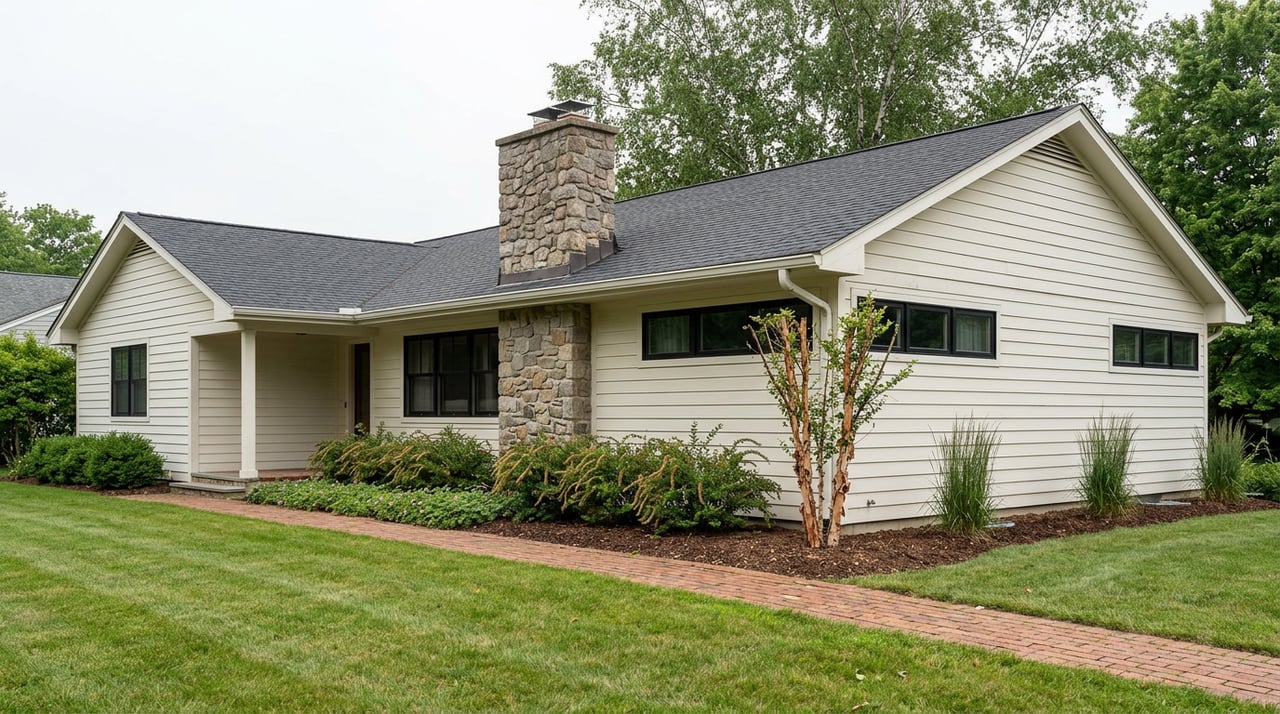
That mix explains why a citywide median tells a buyer so little. A mid-century ranch in one of the established lakeside subdivisions, like Belle Isle or Frost Woods, competes in a different tier than the same-era ranch a few blocks inland, because lake access and a capitol view are fixed and finite in a way that inland lots aren't. Condo buyers looking for an entry point have a small number of established buildings to choose from along East Broadway and near the water, and there simply isn't a pipeline of new ones to compare them against, because there's nowhere left to put them.
Since there's no more waterfront to build on, the city's actual strategy for adding housing runs through the Broadway corridor, the two-mile stretch of four-lane boulevard between South Towne Mall and Stoughton Road. In 2024, Monona created several anticipatory tax incremental finance districts aimed at that corridor, a tool the city is using to make redevelopment financially workable on parcels that wouldn't otherwise pencil out.
The projects already in motion are specific and dated. The River Place multifamily redevelopment at 100-300 River Place was recommended to the city council in March 2025 and is planned across two phases totaling roughly 125 units in buildings six to seven stories tall. A separate senior housing project at 1212 E Broadway was approved in February 2025. Northpointe's Broadway Lofts development, reported by the Herald-Independent to include 42 one-bedroom units and 13 two-bedroom units, adds another 55 units to that same stretch.
The corridor is also getting a commercial anchor. Wisconsin's first Topgolf venue, under construction at 6400 Gisholt Drive near the Beltline and West Broadway, is set to open this fall. Monona's mayor, Nancy Moore, called it an important anchor for the continued redevelopment of West Broadway when the project broke ground. The city's comprehensive plan, last updated in 2016, is also due for a fresh update this year, which will likely shape how much more of this kind of density gets approved along the corridor going forward.
None of this changes the lakefront or the mid-century neighborhoods around it. Those are fixed. What it changes is where new supply actually shows up, and it isn't going to look like a new subdivision of single-family homes. It's going to look like apartments and multifamily buildings along a boulevard that used to be a highway.
A citywide days-on-market figure is a poor first tool for anyone actually shopping in Monona. The number that matters is what's happening in the specific price band and housing type you're after. A buyer targeting an inland ranch in the $400,000s is in a different market than one targeting a lakefront property in Belle Isle, and both are different from someone considering one of the newer units taking shape along Broadway.
For sellers, the takeaway cuts the other way. A home that fits squarely into a tight band, like the $500,000 to $600,000 range this spring, is likely to move closer to that band's own pace than to the citywide average, which means overpricing against stale comps can cost more time than it saves.
For anyone weighing Monona against its neighbors, the honest framing is that this is a city with a genuinely fixed and slow-growing supply of single-family and lakefront homes, and a real but still-forming pipeline of new multifamily inventory a few years out. Both of those facts should shape expectations differently than a single median number ever could.
Does a landlocked supply mean lakefront homes are overpriced? Not based on what the data shows. A fixed supply in a city bordered by water and by Madison on every other side tends to support value over time rather than erode it. The caveat is that lakefront and inland homes are different products competing in different tiers, so comparing one to the other's price trend isn't a useful exercise.
When will the Broadway projects actually add inventory buyers can consider? Approvals moved through city council in 2025, but construction and occupancy timelines for multifamily projects typically run a year or more past approval. The city's own development plans page is the most reliable place to track progress project by project.
Is Monona's market cooling off? Days on market rose locally, but Monona is still selling faster than Wisconsin's statewide median as of May 2026. This reads more like a return to a typical pace than a market in retreat, especially in a city where the supply constraint isn't going away.
If you're trying to figure out where you actually fit in a market like this, whether that's a lakefront property, an inland ranch, or watching for what comes out of the Broadway pipeline, Madison Home Guides can walk through the specific band you're shopping and what the data in it is really saying. Let's Connect.

Alan is committed to delivering a seamless and rewarding real estate experience through expert advice, strategic marketing, skilled negotiation, and exceptional client service tailored to your unique needs.
Alan Feder
ADDRESS 5940 SEMINOLE CENTRE CT STE 310 MADISON, WI 53711